
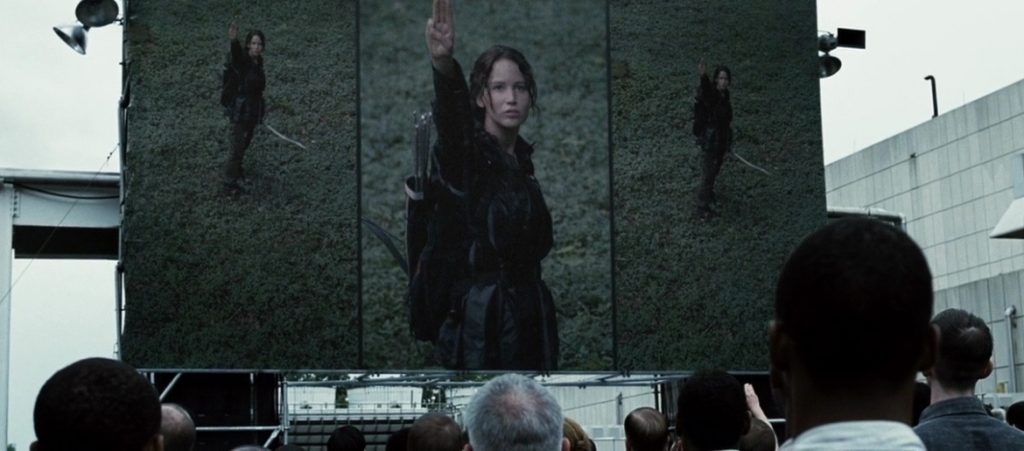
Once upon a time — specifically between 2008 and 2016 — cinema was at its peak. No, I’m not talking about Inception or Frozen (sorry to those films). I’m talking skin glistening in the sunlight. Children reaped from their districts to fight for their lives. Society categorised and divided by personality traits.
That’s right. The holy trinity of film franchises: Twilight (2008 to 2012), The Hunger Games (2012 to 2015) and Divergent (2014 to 2016). The crème de la crème of Young Adult (YA) cinema.
These films didn’t just shape popular culture, they shaped my personality. Is it slightly confronting that I’m still deeply obsessed with YA dystopias a decade later? Absolutely. But if something is powerful enough to launch the careers of Jennifer Lawrence, Robert Pattinson and Miles Teller alongside permanently altering my serotonin receptors, then we can treat the “young” in Young Adult as more of a vibe than a demographic.
Other alumni of the YA Cinematic Universe include Kristen Stewart, Taylor Lautner, Liam Hemsworth, Josh Hutcherson, Shailene Woodley and Theo James — some of today’s biggest screen drawcards (and, in the case of Stewart, that includes behind the lens too).
These films gave us memorable movie moments, for better or for worse. Let’s take Twilight, a film franchise which gave us such contributions to pop culture as:
- The baseball scene — perfection soundtracked by Muse’s “Supermassive Black Hole” — featuring Alice Cullen pitching like a pro (was she anyone else’s sexual awakening, or just me?);
- Depression personified in Bella Swan staring out her bedroom window for three months straight after Edward Cullen dumped her (despite the fact they’d only been dating for five months);
- Edward’s speech to Bella at their wedding (no one tell my girlfriend, but I will be plagiarising it for our own);
- The graphic beheading of beloved vampire daddy, Carlisle Cullen (if that’s a spoiler I’m sorry but you only have yourself to blame);
- And finally, Jacob Black imprinting on baby Renesmee, a storyline that has aged so horribly it’s beyond description.
The Hunger Games and Divergent franchises had many culture-transcending moments of their own — alas, we don’t have the word count to detail them all. But I will say this: Katniss Everdeen did more for my political consciousness than high school civics ever did. Maybe that’s why I ended up working in democratic advocacy?
It wasn’t just the on-screen chaos that I devoured,
it was the off-screen chaos too. Rumours of an affair between Jennifer Lawrence and Liam Hemsworth during their filming years came rushing back into the pop culture zeitgeist in 2023 when Miley Cyrus released her music video for “Flowers”, wearing a gold gown strikingly similar to JLaw’s 2012 Hunger Games premiere dress. The drama! Meanwhile, Kristen Stewart and Robert Pattinson took home MTV’s Best Kiss four years in a row (from 2010 to 2013) before their relationship famously imploded in a cheating scandal (I highly recommend listening to Shameless’ three-part podcast series on this saga).
These weren’t just “films for teens” — they were cultural phenomena that remain relevant to this day. Their legacies live on not in cinemas, but in TikTok videos (if you’re not already, I implore you to follow Lionsgate’s TikTok) and Instagram memes.
Further proof of the 2010s YA impact: the A24 “PR Zoom” for Timothée Chalamet’s latest, Oscar-tipped movie Marty Supreme (a fake meeting staged for the marketing itself, to be clear). In the 18-minute long ‘mansplain’ from Chalamet to the bewildered A24 marketing team, the actor shows images of people who represent American greatness. Among them: Stephenie Meyer, author of the Twilight series. Enough said.
But it’s been a while since we’ve had a fresh YA dystopia brought to life on-screen — let alone one as impactful as these. Why did the genre fall off? Many mid-2010s think pieces attempted to diagnose the downfall, and two main theories emerged.
Firstly, viewer fatigue. Did we need a break from fantasy? The second theory is that the reliance on love triangles got boring. As journalist John Boone put it, “If a teen film franchise exists but doesn’t feature a love triangle between one girl and two brooding dreamy guys, did it ever really exist at all?“
Both valid, but undeniably surface-level theories. I have my own — and it’s political (because, let’s face it, everything is).
During the heyday of YA films, the Big Three dominated political discourse: the Global Financial Crisis, and its immediate aftermath; the US-led invasion of Iraq and the so-called “war on terror”; and rising awareness of climate change.
It was bleak. Teen audiences (myself included) weren’t just seeking escapism — we were seeking emotional processing. YA dystopias weren’t only entertainment, they were symbolic rehearsals for rebellion. Underneath the love triangles and slow-motion forest running, these films helped us reckon with global instability when the world felt too big and too broken.
Fast forward to today, we’re marinating in an eerily similar Big Three: risk of global recession and extreme economic inequality; genocide in Gaza; and full awareness of the climate crisis.
As someone whose day job is tackling one of these crises (climate), let me say it plainly: I need escapism. And I don’t mean another eight-episode dramedy set in a sterile open-plan office. I need metaphorical revolution. A movie that ends with a distressed Katniss watching over a hijacked Peeta, cutting to credits soundtracked by Lorde.
We don’t need realism anymore, because we get that every time we unlock our phones. We need catharsis. We need hope. We need a girl standing in the rubble of a corrupt regime saying, “If we burn, you burn with us!”
My plea to Hollywood is simple: bring back the dystopia. Give me a rebellious braid, a morally complicated love interest and Paramore soundtrack. I volunteer as tribute.
(Honourable mention to Suzanne Collins for rebooting The Hunger Games. She gets it.)
Comments are closed.