
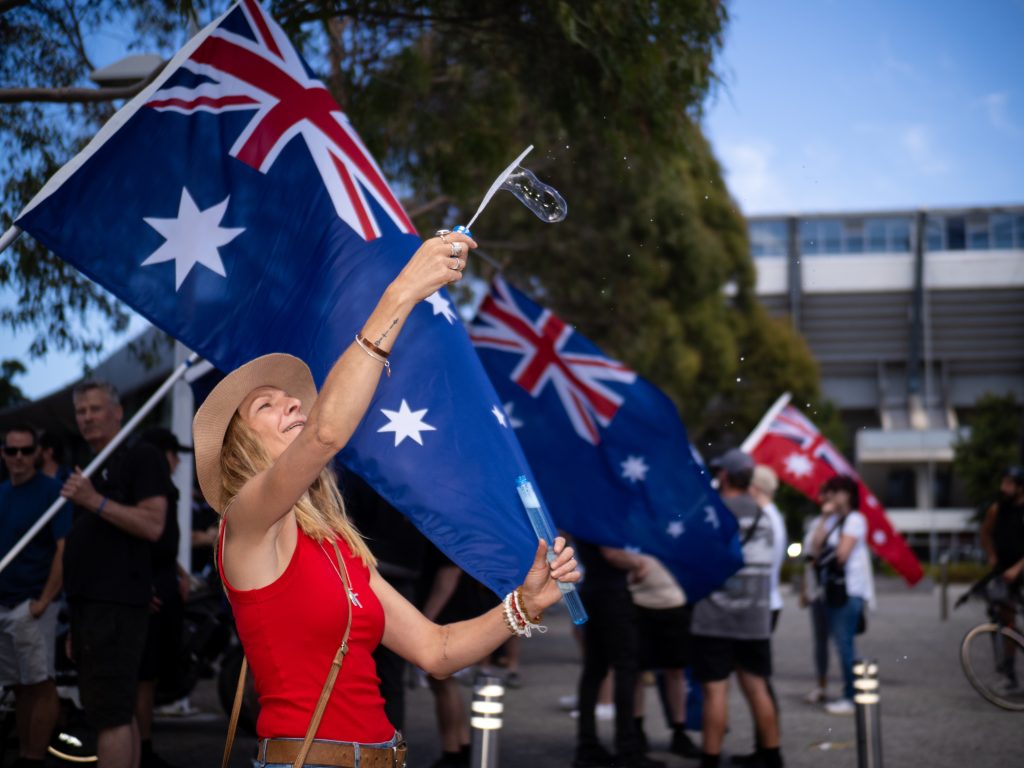
I’m standing in the shade of a gum tree. Behind me, tennis players from around the world are battling it out in the Australian Open. In front of me, neo-Nazi leader Blair Cottrell is speaking about the lifeblood of the nation to a notably unenthused, spaced-out crowd of between fifty and 100 people. He tells them to come closer. They barely shuffle in from their spots in the shade. It’s January 26, 2025 — ‘Australia Day’ to this group, and ‘Invasion Day’ to a much larger group gathered a couple of kilometres away in the CBD.
It’s the most gorgeous, sunny day. A light breeze keeps blowing my hair over my eyes. My cameras are resting at my sides and I’m texting a friend in America. I send her a video of another white nationalist figure, Matt Trihey, using barely-coded language to fawn into his microphone about the White Australia Policy.
“Oh my god, it’s the most beautiful day there and he’s just yapping it away?? About 1973???” she says.
“Yeahhhh… this could have been an email,” I reply.
I leave the apathetic gathering and walk back to the CBD with my friend, mentor, and fellow photojournalist Michael Currie. I apologise for telling him to come to this non-story. He laughs it off. We talk about anything else. I’m thinking about buying a hot dog. I don’t even bother sending my photos of the event to my agency, SOPA Images. It’s not newsworthy and the photos won’t sell. I decide on noodles instead.
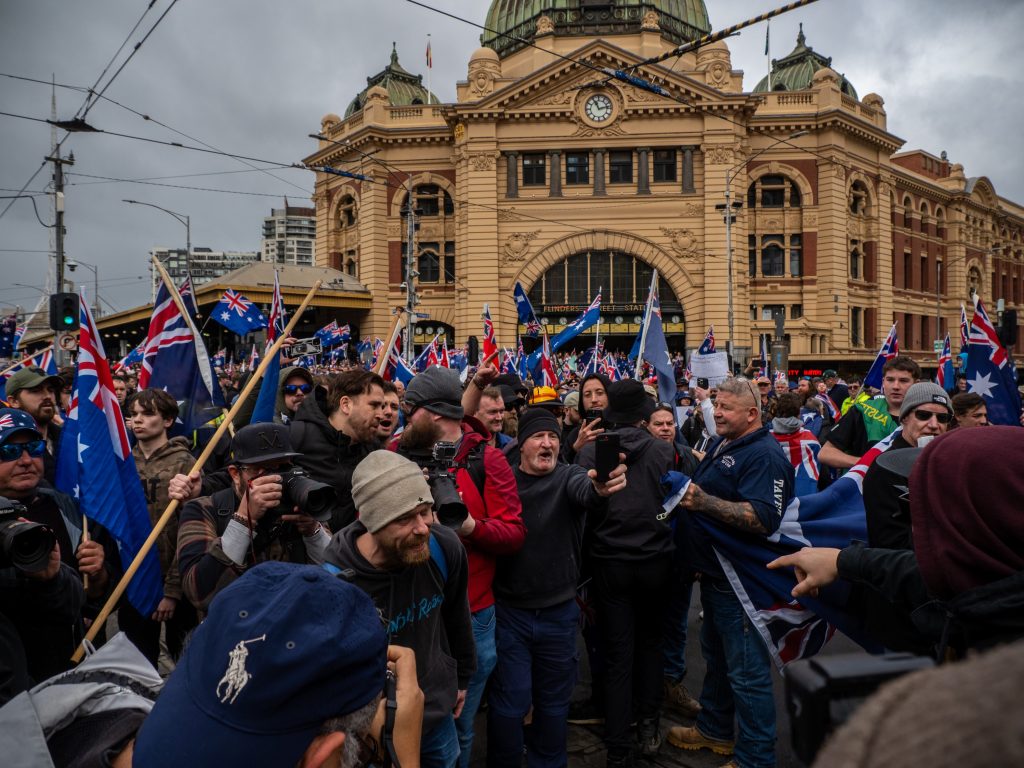
I’m being punched in the head repeatedly by a group of men as jeers erupt from the dense crowd around me. I try to keep my head down and hold my main camera close to my chest. I know my equipment can take a beating but I don’t want to risk losing any of the story. My other, older camera is being pulled in one direction and my hair being pulled in another by members of the neo-Nazi group the National Socialist Network (NSN). Someone drags me away and throws me toward a police line. The officers look but they don’t say anything or move from their place. In front of me, NSN leader Thomas Sewell is addressing thousands of people from the steps of Parliament House of Victoria. Behind me, a sea of Australian flags fills the streets.
It’s 31 August, 2025 and the March For Australia anti-immigration rally is the bloodiest, most unhinged story I’ve ever covered in four years as a photojournalist. I’m just one of many copping it that day. There’s a huge applause as Sewell finishes his speech. The crowd filters away to march back to Flinders Street Station. Someone finds my beanie and hands it back to me. Nice.
Sewell is still on the steps, talking to members of the media and I photograph him doing so. NSN members give me dirty looks. Whatever. I’m in shock but I’m working for Crikey for the first time and I want to make sure they have the best coverage of this shocking day.
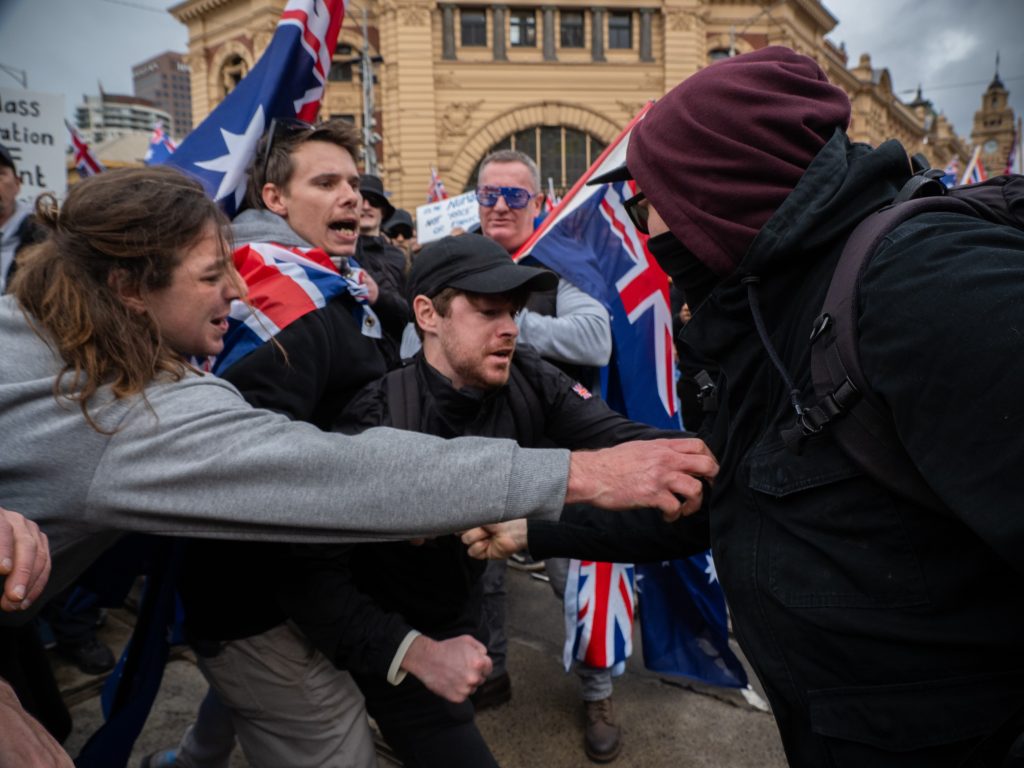
I find one of my best friends, fellow photojournalist Jay Kogler. We walk on the sides of the March for Australia. One protester recognises us.
“Alex!” she calls out, “I knew I’d see you!”
“Hey girl!” I reply, barely mustering a smile. I’ve been seeing her in attendance at right-wing rallies since the anti-lockdown days. I do like her, and I wish I wasn’t seeing her at a rally organised by neo-Nazis. She asks how I’m doing and I tell her what happened at Parliament. She seems disturbed, maybe even angry. I don’t know how it’s surprising, though. They’re Nazis, I’m in the news media and I’m queer. She knows this.
I’ve been watching her posts online go from unapologetically libertarian to ostensibly fascist over the years. It bums me out but I never say anything. She knows ‘Alex Zucco the photojournalist’, not ‘Alex Zucco your good friend from Phoenix’. To be an observer, a documentarian, means keeping your mouth shut sometimes, even when, perhaps especially when, it’s hard.
Here’s what I can say, though: There’s appetite for far-right and anti-immigrant rhetoric in Australia, and it is on the rise. We gawk at America today, at the state of that country’s politics. But I am an American and I remember gawking at North Korea a decade ago, at Vice journalists on a heavily-guided tour of Pyongyang.
Is Australia immune to the authoritarianism we are so shocked by? No. It could happen here. My job, in part, is to show you that it can. What you do with that information is up to you.
It is wholly possible that the political situation in Australia shifts wildly as a result of concerted efforts by those labelled extremists today. As I write this, however, the far-right movement in this country is fractured and confused and a whole cast of people are vying for relevance or for a top spot. Since the August 31 rally at least four other nationalist rallies have been organised in Melbourne. None came anywhere close to the scale or the incredible violence of that first March For Australia.
The reason for that scale, and why that has not as-of-yet been replicated, is what interests me.
Are there really so many thousands of neo-Nazis ready to swarm the cities of Australia? No. Are there really so many violent racists, ready to break people’s noses in broad daylight? Probably not.
When I started working in 2021, I met a surprisingly diverse mix of attendees at Melbourne’s anti-COVID-19 lockdown, anti-restriction and anti-Dan Andrews protests. I believe most were good people with good intentions. Some weren’t. But this scene was becoming more and more isolated and the algorithms of YouTube and social media, as well as self-radicalising online communities they found, led many to increasingly out-there and anti-social places. I couldn’t estimate how many told me their friends and family stopped talking to them because of their beliefs.
Yet, they found community in the Freedom Movement — for a time. They found validation, importance and human connection. Even so, all they really had in common was clicking the same kind of content on social media. Eventually, cracks formed and then deepened. In time, there was no coherent philosophy to unite behind and less and less people remained involved.
Today, a new right-wing movement is forming, spurred on by nationalist movements abroad and economic woes at home. The most radical elements of the nationalist movement are looking to funnel the more pedestrian among their cause towards their extraordinary beliefs. Many aren’t biting. Neo-Nazism is deeply unattractive to most, for obvious reasons. They have poisoned causes in the past and they could be the undoing of the new nationalist movement. They may also be the last ones standing when the dust settles. Neo-Nazis are the logical conclusion of xenophobia, and those attempting to lead the movement to somewhat less extreme positions are finding themselves outmatched and are not rising to the moment.
The next March For Australia is scheduled for January 26. It remains to be seen how many will skip the beach and the barbeque to attend, and likely clash with the Indigenous-led Invasion Day rally. I’ll be on the ground either way, clicking away at what’s unknowable for now.
I hope it’s a nice day.
All images by Alex Zucco.
Comments are closed.